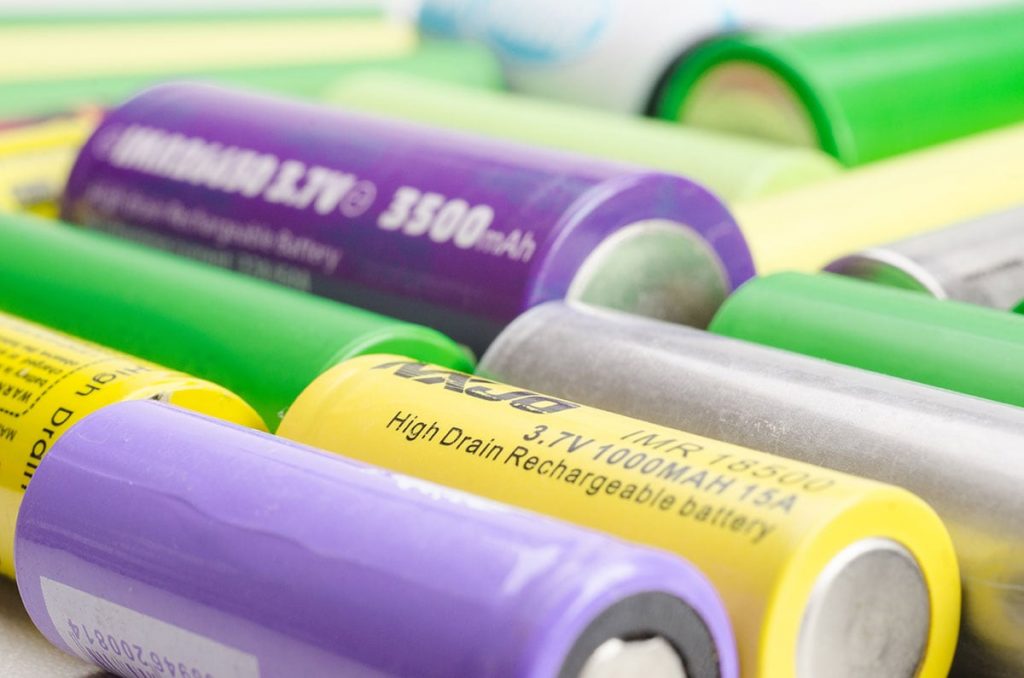
The vape industry is anything but the tobacco industry, but with the market introduction of around 150 million 10 ml bottles and hundreds of thousands of electronic devices available, only in France, the vast majority of which come from China, it contributes its share of pollution. Fortunately, it is possible to reduce its carbon footprint by adopting best practices, some of which are legal obligations.
Glass, paper, cardboard, plastic, electronics, metals, the vape industry produces many different types of waste that must be recycled for reuse or disposal, thus limiting the environmental impact of the sector. In particular, stores are legally required to make an ecological contribution and collect batteries, battery packs, and electronic devices. “We are a young sector and we have gradually built ourselves by doing things in a very empirical way, and like in other sectors, including training, we are catching up,” explains Sébastien Rempp, director of Yes Store, a member of the Fivape board.
 Polery/ Paid
However, as in other sectors, the polluter-pays principle applies. “Companies that import and market products must pay, and companies that sell to the end customer are required to take them back,” adds Rempp. Sometimes, it’s the same actor. Take the case of a company that imports from China, must pay and collect the eco-contribution.”
Regarding toxic waste, such as batteries or nicotine e-liquid bottles, it is important, in addition to recycling, to place them in the correct cycle. For example, if nicotine waste is buried in large quantities, it will pollute the soil. “Similarly, batteries create contamination when they enter household waste and are burned. The idea is not necessarily recycling; it must already be responsible for the toxic elements that make up our products,” adds Sébastien Rempp.
Glass, paper, cardboard: it’s easy
This is the best recycling in France. Wholesalers can contact companies like Veolia to collect packaging boxes. Others condense it and report it to the local operating union. In stores, the system differs depending on the city, but most often they must fold and tie them and place them in a certain location. For cardboard and glass, they must be placed in designated containers.
C Bottles
As already mentioned, vaping produces many caps (about 150 million per year). They are made of HDPE or PET and are not dirty, thus recyclable. When recycled, they are turned into plastic parts such as vehicle parts, flower pots, technical parts in construction, etc.
What needs to be done
It is the role of stores to collect them. There are several ways to act. Either by contacting specialized companies like C2P in the North, or by reaching out to associations such as Heart of Plugs, Love Plugs, or the Stoppers of Hope, which also work for disabled people. Fivape is in contact with them; you can reach out for more information or contact them directly.
Electronic equipment
This concerns waste from electrical and electronic equipment (WEEE). Companies that import, brand, and/or produce are considered producers. A company that sells products purchased in France (for example, from a French wholesaler) is just a marketing company.
Duties
The dealer:
- visible separate display of Eco-participation;
- collection of the used device at the point of sale or return in 1 to 1 (from which one has been restored for one sold), including web operators;
- if the point of sale is over 400 m2, it is mandatory to take back 1 to 0 (without necessarily having an equivalent device, for example, via collection furniture);
- delivery of waste to the selected sector.
The producer (manufacturer or importer):
All previous obligations in case of distribution. In addition, any EEE placed on the market after August 13, 2005, must be marked with the following components:
- a label allowing identification of its producer and determining that it was placed on the market after this date;
- a pictogram “waste crossed out.” If the dimensions of the device do not allow it, this pictogram will appear on the packaging and on the associated warranty documents and user instructions.
It must also contribute to the collection of electrical and electronic equipment through an eco-organization. Electrical and electronic equipment placed on the market in France is subject to:
- a declaration to the eco-organization;
- a visible billing of eco-participation.
Glossary: what is a producer?
According to the Environmental Code, the concept of distributor includes companies that manufacture or import (or import from the EU) or resell under their own brand, or sell electrical and electronic equipment (EEE) directly from abroad.
To be supported in these tasks, it is necessary to return to an eco-organization. In fact, it handles registrations, declaration procedures, tax collection, and reprocessing of WEEE.
Glossary: what is a marketing specialist?
Any wholesaler, store, or long-distance call that imports batteries or cartons and offers them for sale (or as a donation) for the first time on national territory is a marketing market.
Batteries and accumulators
Market counters
They are responsible for the collection, recycling, and communication with the authorities of batteries or accumulators placed on the market, including organizing removal, processing, and recycling at a sufficient yield, but also the membership of their company and the transfer of declarations to the Ademe. This is heavy, tedious, and time-consuming. The French state has also authorized two organizations, Scrolec and Corepile, to manage these restrictions instead of the merchants.
Market counters must therefore:
- adhere to an eco-organization (Membership Agreement);
- submit an annual declaration of the accumulators placed on the market for N-1 to the eco-organization;
- pay their annual contribution based on the weight and type of accumulator technology.
Distributors
The dealer is required to collect portable batteries and accumulators from customers free of charge and provide them with recycling channels. “We also recommend that distributors check that their French supplier has complied with their obligations to participate in an eco-organization,” explains Sébastien Rempp from Fivape.
How much does it cost?
Marketing specialists
The annual contribution is calculated based on the weight of the collected accumulators and the technology used. For example, the contribution from screec for a 47 g lithium battery is €2.25 per 100 units placed on the market (See SCREL and Corepile scale).
— Regardless of the selected ecosystem, minimum non-compressible annual contribution costs will be provided: €150 for Scleec, €200 for Corepile (indicative prices 2018).
– See the Sriec and CorePile membership agreements for more details.
Distributors
— The store has the option of using an unauthorized waste provider: the collection and recycling service is paid.
— If the store uses one of the biological organizations, it provides collection boxes and offers a free pickup service (contributions paid by merchants fund this service).
It should be noted that Screlec offers the following solutions:
• Fixing the storage of accumulators (billage tape and vermiculite), which is particularly well suited to the problems of vape workshops;
• The possibility of dropping off full boxes at one of the 30,000 collection points without waiting for pickup to minimize storage and risks;
• Different sizes of collection material Batribox and providing information and media to store employees and customers.
Here are some examples of data for a few batteries:
| Features | Brand format | weight of
| |
barcode |
|
| EFEST | 18650 | 3,500 mAh 20 | 6 958946 201583 | 47 g |
| MXOJ | 18650 | 3,500 mAh 20 A | 6 924135 616100 | 47 g |
| MXOJ | 18650 | 3,000 mAh 20 A | 6 924135 635798 | 47 g |
| EFEST | 18500 | 1000 mAh 15 A | 6 958946 200814 | 32 g |
| MXOJ | 21700 | 4000 mAh 20 A | 6 924135 604190 | 70 g |
Summary
You are a reseller: collect batteries and regularly place them in the nearest store bin (supermarket, hardware store, etc.) or once you reach 60 kg, contact a collection agency to arrange a pickup.
You are a director in the market: join a recovery agency, and in addition to collecting, you will need to specify your imported volumes and pay a contribution based on them.
Polluted waste (bottles, resistors, etc.)
This applies to plastic from nicotine e-liquid bottles, used resistors, or clearomizers and atomizers. These are the items currently causing the most problems, as there is not yet a recycling chain. Bottles could be easily recycled, but the “skull” icon remains an issue.
Fivape and various stakeholders will work on this issue in consultation to reach a solution. However, it should be noted that manufacturers are legally required to have them collected by intermediaries such as Interchemistry, which disposes of e-liquid in a class 1 landfill dedicated to hazardous products and extraction, particularly hazardous liquids, to limit chemical reactions in the pit.
Individuals can also return their e-liquids to manufacturers who are required to have them collected according to this protocol.
Summary
If you are a reseller: Collect and remove the bottles (it is not mandatory for empty bottles that can be placed in household waste by your customers) and contact a collection agency such as Interchimie, Chimirec, or Veolia for collection (paid).
If you are a manufacturer: Join a REP organization in addition to the obligation to pay for the reprocessing of bottles (unsold, expired, etc.).
Organic organizations: how does it work?
There are 2 in France: Ecosystèmes and Ecologique. It’s easy and doesn’t cost anything. Membership in an eco-organization is free. There is no minimum payment threshold. There are no fees other than the ecological payment tax according to a schedule that sets the amount by type of product sold. Be careful, the scale of vape products may vary from one organization to another.
This balance is simple in the case of the vape sector, as sales often only include one type of device (batteries, cartons) with low weight. Reports are made every six months in the form of a single line with a unique code indicating the tonnage for the semester and the amount to be paid.
Summary
You are a reseller : Collect items that contain electronics and cables and regularly place them in the tray of your nearest store (supermarket, hardware store, etc.) or contact a collector to arrange a pickup.
You are a marketer : Join a recovery agency, and in addition to earning, you will need to specify your imported volumes and pay a contribution (EEE). This item must appear on the sales invoice of the product.
Influence of
Material Most hardware manufacturers are based in China. In addition to harmful transportation for the environment, products are often packaged. It is helpful to raise public awareness about reducing their carbon footprint. At the end of Vapexpo Nantes, Vapostore met many manufacturers to change certain practices. “There are brands like Vaporesso that have already planned to reduce their packaging as compact as possible. Innokin no longer films its boxes. They will replace the film with small seals. It is interesting to see that manufacturers are attentive to this issue,” explains Maxime Taglione, development manager at Vapostore.
A solution for bottles?
While bleach bottles, for example, benefit from recycling channels, e-liquid bottles from these nets are forgotten. The skull is an obstacle to managing bottles by recycling agencies. Jean Moiroud, president of Fivape, is optimistic about the development, as recycling is also a business that generates a lot of money. “What is needed to solve this story is to decode nicotine from toxic products to find companies that collect our bottles. With Fivape, we are trying to make this understood by the authorities. Our bottles could be recycled into urban furniture, that is, into non-food products, so there is no problem. We have already contacted companies that are interested. But we are just starting; it’s very complicated,” estimates Grégory Avril, director of Toutatis and a member of Fivape, who is very involved in this file.
A malus bonus for unrecycled plastics
Following the ban on disposable plastics, which was postponed by the Senate to 2021, this concerns the tax on unrecycled plastics. Starting in 2019, the government will gradually implement a bonus-malus system to help consumers focus on recycled plastic products.
Brune Poirson, Secretary of State for Ecological and Solidarity Transition, announced this in the summer of 2018. “We will use a bonus-malus system of up to 10% of the price of products to mobilize the consumer. Tomorrow, if you can choose between two bottles, one in recycled plastic and the other not, the first will be cheaper,” said the Minister of Foreign Affairs. The objectives are multiple: together, to reach 60% of packaging in recycled plastic by 2022, eco-designed packaging, making it 100% reusable, recyclable, or compostable by 2025. This measure currently imposes no regulatory restrictions on industrialists.
Liquid, fewer waste solutions
- The cardboard tube, the plastic seal, and the folded notice can be marked with a packaging label according to the law. can be replaced.
- Advocacy to return to the 10 ml limit, which would produce less plastic for the same volume of e-liquid.
Sealed pods or disposable clearomizers, an ecological aberration
Non-recyclable, plastic, metal resistors, extremely limited lifespan of an average day, sealed pods and clearomizers are clearly a thorn in the side of environmentally friendly vaping. While they are convenient for visually impaired people, for example, they should be avoided as much as possible, and it is better to move towards open systems that can be used multiple times, especially since they are complicated to recycle.
Recycling tips you can find in the
- Plastic packaging: Place it in a CollectiBio tray available in many natural food stores (Biocoop, La Vie Claire, Naturalia, etc.).
- Cardboard packaging: The yellow bin.
- Bottle cap: The yellow bottle
- container with nicotine-free e-liquid plastic: the yellow bin.
- Glass bulb: Glass Street
- Return the cap to the store if it has its own collector.
- Batteries and accumulators: Return to the store or in a collection container at a large surface.
Going beyond recycling, examples to follow
Recycling is good, but less waste is better. Some vape companies are already aware of this and are applying new working methods. For example, Kumulus Vape is responsible for manufacturers, particularly on the subject of over-packaging. It optimizes the processing of different types of waste for recycling (collection and dedicated landfills) through selective sorting containers for its employees. It consumes “green,” particularly through the use of environmentally friendly cleaning products, banning plastic bottles and utensils, removing coffee capsules in favor of fair trade coffee beans, etc. It goes even further by reducing electronic messages to strict necessity and favoring snapshots from messaging systems.
Reducing waste production
The Lyon-based company regularly raises awareness and trains its employees on good environmental practices. Within 3 months, it will ban the printing of documents for internal use. It will use recycled paper for all its communication means. It will plant trees in its business park (ongoing discussions with the owner) and install a green waste composter available to its teams. Finally, it is exploring other projects, such as the possibilities of offering its customers a real recycling service for vape products or an environmental protection measure by supporting their purchases.
On the liquid side, VDLV uses bottles made from recycled plastic. Its pre-fabricated e-liquids use nicotine from locally grown tobacco, and its employees sort waste. In the future building, which it will integrate in September, VDLV will apply the principles of the circular economy. Similarly, the vapostore chain recycles boxes and ink cartridges and removes cups and plastic sorting containers are set up in their stores.
5 / 5 ( 1 vote )
Tag : Does an electronic cigarette recycle?