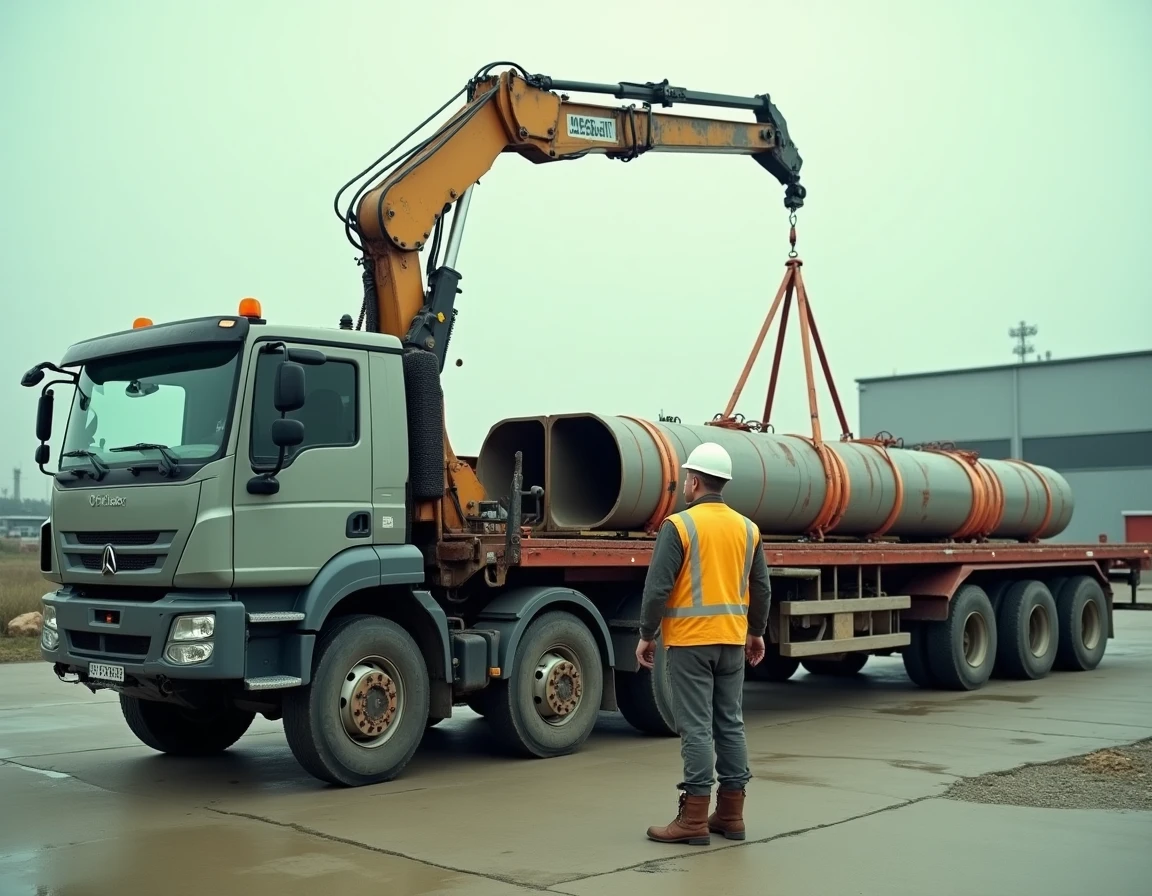
Placing an 8-ton tank on a site not served by a crane, delivering prefabricated concrete panels to a site without a unloading dock: these situations require a vehicle capable of transporting and handling the load on-site. The flatbed truck equipped with an auxiliary crane meets this need by combining an unobstructed loading space and a hydraulic lifting arm mounted directly on the chassis.
Auxiliary crane on chassis: what changes compared to a mobile crane
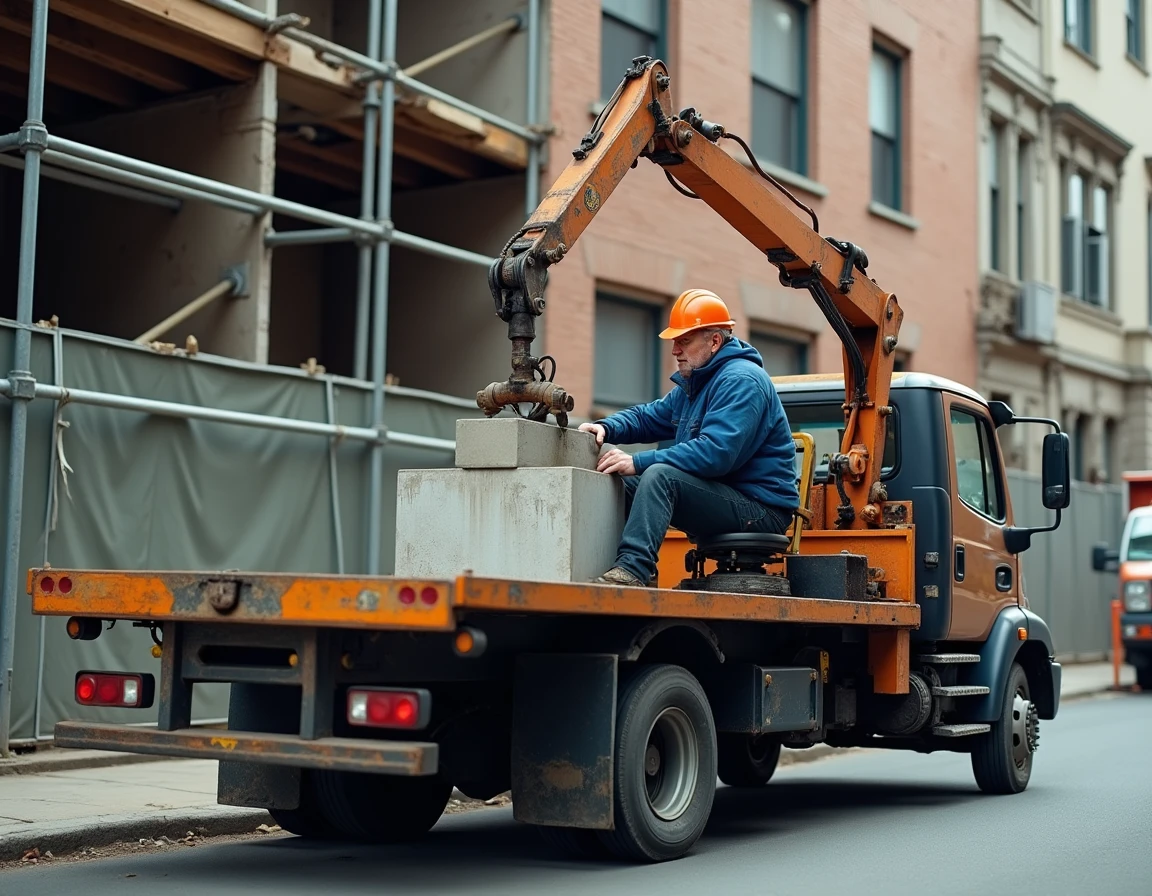
On paper, both a flatbed truck with a crane and a mobile self-propelled crane can lift heavy loads. The difference lies in the overall logistics of the operation.
A mobile crane requires a dedicated convoy, sometimes exceptional transport to get it there, and then a second vehicle to bring the goods. The flatbed truck with crane eliminates this double mobilization: the same vehicle transports the load and delivers it at the destination. On an urban renovation site where ground space is limited, this autonomy saves several hours of setup time.
The most powerful auxiliary cranes now reach 95 ton-meters and more, mounted on standard road chassis. This level of capacity allows for lifting containers, prefabricated modules, or industrial parts without mobilizing a self-propelled mobile crane. However, for lifts beyond this range or very high boom heights, the mobile crane remains the only option. Feedback varies on this point depending on the site configuration and the actual weight of the parts.
To better understand transporting with a flatbed truck with crane and its specific uses, one must think in terms of site constraints rather than raw lifting capacity.
Lifting capacity and flatbed configuration: the criteria that guide the choice

Choosing a flatbed truck with crane involves balancing three related parameters: the residual payload of the chassis, the lifting moment of the crane, and the length of the available flatbed.
Lifting moment and reach
The lifting moment, expressed in ton-meters, defines what the crane can lift at a given distance. A 30 t.m crane lifts 3 tons at 10 meters but 6 tons at 5 meters.
The required reach depends on the distance between the parking point and the drop-off area. On an accessible site, the truck can be brought closer, increasing capacity. On an enclosed site, the boom must be extended further, which reduces the allowable load.
Number of axles and payload
A two-axle chassis offers a shorter flatbed but better maneuverability in the city. A three or four-axle chassis increases the payload and stability during lifting, at the cost of a bulkier size. The choice directly depends on the tonnage of the parts to be transported and the access conditions to the delivery site.
Crane mounted at the front or rear
The position of the crane arm on the chassis affects the vehicle’s behavior and the ergonomics of handling:
- Crane mounted at the rear of the flatbed: suitable when the drop-off is done behind the vehicle, typically on a dock or roadside. The driver can see the load throughout the maneuver.
- Crane mounted at the front (behind the cabin): the most common configuration. It frees up the back of the flatbed for loading and allows for unloading on the side or in front of the truck.
- Crane on a rotating turret: offers complete rotation and greater flexibility for unloading, but adds weight and reduces the usable length of the flatbed.
Cost of a flatbed truck with crane: purchase, rental, and rising factors
The price of a new high-capacity flatbed truck with crane can reach 600,000 euros according to updated pricing guides for 2026. This amount includes the chassis, the auxiliary crane, stabilizers, and onboard safety equipment. The range varies significantly depending on the chosen lifting moment: a 25 t.m model costs significantly less than a 95 t.m machine.
For rental with an operator, daily rates typically range from 600 to 1,000 euros per day. This increase compared to previous years is explained by two combined factors: the cost of the equipment itself and the scarcity of qualified drivers.
Qualifications for driving a flatbed truck with crane: license, CACES, and ongoing training
A flatbed truck with crane cannot be driven with just a standard heavy vehicle license. Recent job offers show that a driver must hold several certifications that have become industry standards:
- C or CE license depending on the GVW of the chassis and the possible presence of a trailer.
- FIMO (Initial Minimum Mandatory Training) or FCO (Mandatory Continuing Training), with an up-to-date driver card.
- CACES R486 for operating auxiliary cranes or lifting equipment.
This accumulation of qualifications partly explains the tension in the job market for heavy load transport. Recruiting a driver who can operate both the chassis and the auxiliary crane takes time, and transport companies pass this cost onto their service rates.
Safety on-site: stabilizers and lifting plan
Before each lifting operation, the driver deploys the hydraulic stabilizers of the truck to ensure the vehicle’s stability. A soft or sloped ground alters the actual capacity of the crane, sometimes significantly. On demanding sites, a detailed lifting plan (weight of the load, drop-off distance, nature of the ground) is established in advance to avoid any risk of tipping.
Preparing the loading and unloading area remains the most underestimated factor. Clearing access, checking the ground’s load-bearing capacity, ensuring sufficient space for deploying stabilizers: these steps are as crucial to the success of the operation as the choice of equipment itself.