A sitemap applied to gardening functions like an interactive summary: each link points to a thematic category (vegetable garden, fruit trees, perennials, seasonal maintenance) and allows access to the sought information without browsing through dozens of pages. This principle of structured navigation is used by most horticultural portals to organize hundreds of articles, plant sheets, and practical guides.
Biodiversity and climate resilience: the angle that gardening summaries now incorporate
The most up-to-date gardening portals no longer classify their content solely by plant type or season. Since 2023, a logic related to climate resilience has structured new sections: water-efficient species, ecological corridors, pollinator-friendly plants.
The French Office for Biodiversity published a guide in 2023 titled “Nature-Based Solutions for Private Gardens.” This document explicitly mentions the use of digital planners to visualize shaded areas, diversified hedges, and ecological continuities. A gardening site that organizes its content around these themes offers a more relevant entry point than an alphabetical listing by variety name.
The French Federation of Landscape, in its updated “Resilient Landscapes” file in 2024, confirms that the specifications for professionals now include resistance to heatwaves and dry soils. Amateur gardeners looking for suitable perennials or water-efficient varieties need a site structure that reflects these concerns, not just a catalog by flower color.
Browsing the Info Gardening sitemap provides a concrete overview of this type of thematic organization applied to a generalist portal.

Structure of a gardening sitemap: categories, sub-sections, and navigation logic
An effective sitemap relies on a two or three-level hierarchy. The first level groups the main families: vegetable garden, ornamental garden, trees and shrubs, maintenance, tools and equipment. The second level refines by sub-theme (sowing, cuttings, pruning, diseases). A third level, when it exists, goes down to the individual sheet of a plant or tool.
This hierarchy is not arbitrary. It reproduces the way gardeners formulate their searches: first a general domain (“roses”), then a specific action (“prune a climbing rose”), then a specific context (“pruning climbing rose after late frost”).
What a well-constructed sitemap reveals
A well-structured sitemap indicates the gaps of a portal. If the “watering” section contains no sub-category on rainwater harvesting or drip irrigation, the site lags behind current practices. Several French metropolitan areas (Lyon, Montpellier, Nice) have implemented regulations between 2023 and 2024 governing the watering of private gardens during water scarcity.
A gardening portal that does not incorporate these regulatory constraints into its structure misses a real demand from readers.
- A “water management” section should cover at least: rainwater tanks, drip irrigation, mulching to limit evaporation, and species with low water needs.
- A “biodiversity in the garden” section benefits from separating content on pollinator-friendly plants, wild hedges, and wildlife refuges (insect hotels, birdhouses).
- A “digital tools” section can list planning software that includes biodiversity modules, like those mentioned by the OFB in its 2023 guide.
Planning software and sitemap: two complementary tools for designing your garden
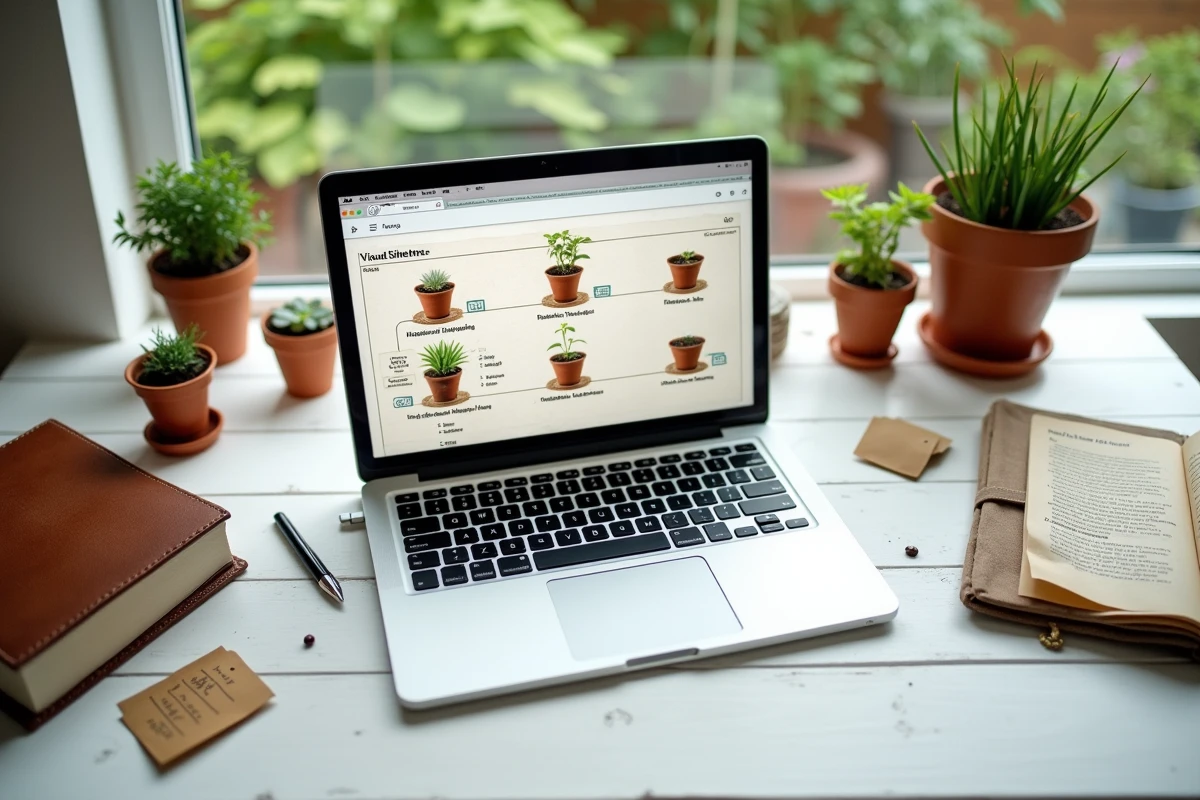
There is often confusion between a website sitemap and garden planning software. The former organizes editorial content. The latter allows for designing a layout on a real surface, with constraints of distance, sunlight, and compatibility between species.
Both complement each other. A gardener using a garden planning software to position their flower beds and vegetable garden needs, beforehand, reliable technical sheets on each chosen plant. The sitemap of a gardening portal helps them quickly locate these sheets without going through an external search engine.
Biodiversity modules in digital planners
Since 2023-2024, several garden planning applications have added modules to visualize ecological corridors and shaded areas. The OFB guide cites this evolution as a lever for private gardens to participate in ecological continuities at the neighborhood or municipal level.
A gardening site that references these tools in its structure (section “garden application,” “landscape software,” “design your green space”) facilitates the transition from consulting articles to taking concrete action in their own garden.
Using a sitemap to progress in gardening: reading method
Browsing a gardening sitemap without a specific goal does not yield much. The most productive method is to start from a concrete problem (a plant that is wilting, a poorly utilized space, a variety to choose) and navigate up the hierarchy to identify related content.
For example, a reader looking for information on drought-resistant perennial varieties can, from the “perennials” section, discover articles on mineral mulching, soil preparation in calcareous terrain, or choosing an appropriate irrigation system. This lateral navigation, made visible by the sitemap, advantageously replaces a series of isolated queries on a search engine.
A sitemap also makes the editorial depth of a portal visible. A gardening space that displays several hundred plant sheets classified by botanical family, exposure, and water needs reflects substantial work. In contrast, a sitemap that contains only a few dozen generic entries (“flowers,” “trees,” “vegetable garden”) indicates superficial content.
The sitemap remains an underestimated navigation tool. Careful reading allows for identifying themes that the reader might not have spontaneously searched for, and broadening their knowledge on subjects such as applied botany, plant associations, or the ecological management of a green space.