Executive Summary
- Are you sure about the location you have chosen?
- The first step is to choose the right location.
- The criteria for choosing a good location are the same as for an inground pool.
- The pool must be installed on a flat and stable surface.
- How to level and stabilize the position?
- To summarize
Preparing the ground is essential to limit unfortunate accidents and beginner mistakes. It doesn’t matter what type of above-ground pool you install.
Type of example (and a little beast): Nothing prevents you from installing your above-ground pool on sloped land. But when you fill it, the water will distribute according to the laws of physics. The weight of the water pushes on the lower side of the structure. The pool will eventually collapse or tilt. And all the water will flow down the slope. Eventually, you’ll have soaked everything below and will have to start over. And maybe even buy a new pool…
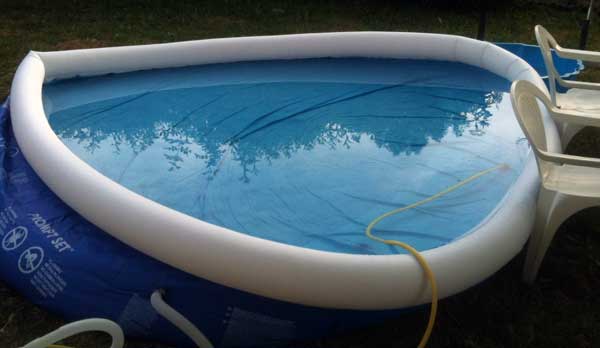
Never (ever) install your above-ground pool on sloped land… (image source)
This is a key example. And there are others to consider for properly installing your pool. But remember here that the challenge of preparing the ground is to be able to comfortably enjoy your above-ground pool every day. You bought your pool to enjoy it, not to have it be a concern.
This is what needs to be done. It’s not very complicated: you need to choose the right position, then level and stabilize the position if necessary.
Are you sure about the location you have chosen?
Once the pool is filled with water, it will no longer be movable without emptying it. It will be too heavy. It’s best to choose the right location from the start.
The first step is to choose the right location
The space and terrain you have will naturally guide your choice. On the outer surface occupied by the pool, you need to add the need for space to easily move around the pool, to get in and out of the water, and to place chairs.
The criteria for choosing a good location are the same as for an inground pool
— The pool is a set in which it is necessary to take into account the internal surface of the pool, its external surface (if it is equipped with braces for example) and the following peripheral arrangements (deck, shower, etc.).
— Preferably choose a sunny spot with little wind exposure and away from natural pollution like tree leaves or clusters of tall plants. The sun and the absence of winds will be your best allies for enjoying swimming better.
— If possible, the location should also be a good distance from the neighborhood. To protect your privacy or to shield them from the noise of using a pool.
— The proximity to a water source for filling the pool and an electrical connection for operating the equipment should also be considered. In principle, since you will not be digging into the ground, you don’t have to worry about the presence of underground pipes. But it’s best not to install your above-ground pool over underground pipes.
So far, nothing complicated to understand. It’s up to you to find the best compromise in terms of the size of your pool and the space you have. If the pool has not yet been purchased and you have limited space available, it is advisable not to choose a pool that is too large.
The pool must be installed on flat and stable ground
If the chosen position is flat and naturally stable, it will be easy. Otherwise, it will be necessary to level the ground to make it flat, to limit the risk of increased humidity and stabilize the deformation of the bottom of the pool due to rocks or tree roots.
Three options here: — geotextile only. — sand geotextile. — or concrete slab.
This depends on the type of pool and the type of terrain.
If it is an inflatable, standalone, or tubular pool on flat grass that is dismantled at the end of the season, a geotextile alone will suffice. The goal is to prevent the regrowth of plants and the rise of damp soil.
If it is a permanent installation (large inflatable or tubular pool, pool with rigid panels) or if the position is not flat, the base of the pool will need to be leveled and possibly stabilized.
How to level and stabilize the position?
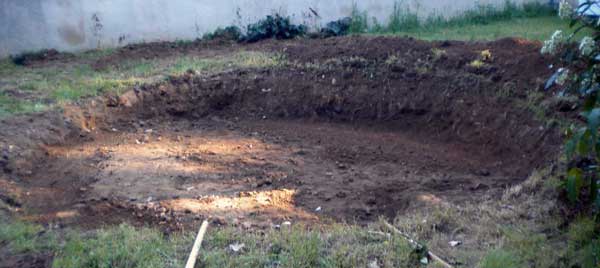
— Draw the outer contours of the pool. — Remove 5 to 10 cm of soil from the area you have marked. — If the ground has a slope, it will need to be adjusted to obtain a flat surface. Use string, a mason’s level, or an electronic level if necessary.
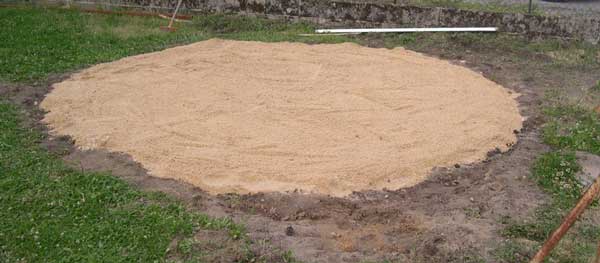
— If it is a medium-sized inflatable or tubular pool, and the ground does not contain rocks or tree roots, a layer of sand a few centimeters thick is usually sufficient. To compact the sand, you need to water it, and even better, use a roller. Then lay a geotextile felt on the layer of sand to prevent plant regrowth.
— If it is a large inflatable or tubular pool, a pool with metal or wooden panels with braces, or if the ground is rocky, with tree roots, you need concrete to create a position that will remain flat and stable over time. It’s up to you to decide whether to pour it or not. A simple mesh can do the job.
A concrete slab requires more work but is a necessary condition to protect you against unfortunate accidents. Some manufacturers of above-ground pools (large size, panels) require it.
To summarize
To properly install an above-ground pool, you need to choose the right location and prepare it. It’s much easier for an above-ground pool than for an indoor pool.
A good location is stable, flat, sunny, sheltered from the wind and surrounding nature, at a good distance from prying eyes, with sufficient circulation space around the pool.
The location can be prepared in 3 ways: on a geotextile, on a layer of sand geotextile, on a concrete slab. Some models of above-ground pools require a concrete slab for the warranty to be valid in case of technical issues.
In general, it’s nothing complicated. And if needed, don’t hesitate to get help.
Tag: putting a pool on sloped land