Even before the turn of the year, the calls from crisis prophets were hardly missing. What’s going on? More importantly, are you ready for the stock market crash? I will show you 7 tips on how to prepare your mindset for falling prices.
The last time a downturn swept through the markets was in the summer of 2019. The causes were quickly identified: weakening economic signals, the trade conflict between the United States and China, Brexit, and the government crisis in Italy. The market anxiety barometer, the VDAX volatility index, rose significantly to 27.17. And now at the beginning of February 2020? Not much better politically. And the markets? They had been rising eagerly until a few weeks ago. Since the declines in August 2019, the DAX and S&P 500 have recorded about 13% and the ATX about 10% (as of 31.01.2020). The VDAX is slightly higher at 3.3 after its low on January 17, 2020. Is it going well on the markets? Or is the crash coming?
Is the big showdown coming in March 2020?
The only true and honest answer to this question: I don’t know. And no one else does. Nevertheless, there has been a flood of new forecasts just in time for the start of the year. Your added value? They satisfy our thirst for guidance in the uncertain world of the stock market. Crisis forecasts are important. The more dramatically they are stated, the greater the attention. Your value in terms of entertainment factor? Zero. Some arguments seem plausible, some predictions clear and rigorous. Nevertheless, it can be quite different. Since 2013, there has been a high economic cycle for accident forecasts. On the market: After the crisis is before the crisis. Investing money is not a one-way street. One day there will be a slowdown and hysteria, justified or unjustified. Only when, honestly, no one knows.
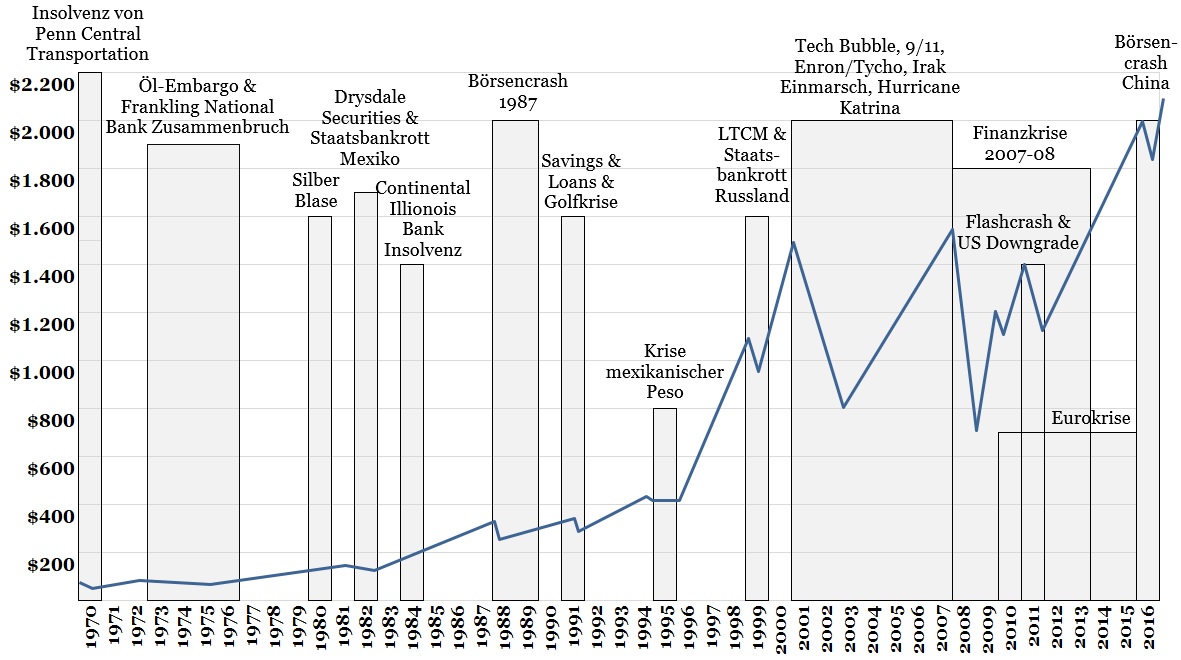
I consider crash forecasts mainly as stock market horoscopes. In my eyes, you waste your money with these predictions. Because: The biggest danger to your money is you.
The biggest risk of a crash? You and your investment decisions.
History shows that it is not the stock market crash itself that causes high capital losses for private investors. On the contrary, it is our behavior in crisis situations. An effective way to protect your capital is to adapt to the crisis. Investors with a long investment horizon have historically been successful if they remained true to their investment strategy. Those who followed their emotions and sold in panic during price drops usually miss the rebound.
Take the opportunity to face headwinds in the investment market. As soon as it turns, it is too late. Then emotions, such as fear and panic, determine our decision. They only know one thing: after a shock rigidity, the panic exit from the investment drop follows.
7 tips for a cool head in a bear market.
Make your Money Mindset suitable for stormy trading hours with these seven tips. It is guaranteed that this is not about diversification, risk reduction, or cash contingency. It’s about you, your head, and your stomach.
Tip 1: Learn from past crises.
When we are surprised, emotions dominate our decision. If we rely on an outcome, then we decide more rationally. Anyone who faces previous financial crises will get a better idea of those moments. A review shows that market crises are more frequent than we think. And they have astonishing parallels. A look at crash histories even reports for experienced investors. A sober review allows for insights that remain hidden from the emotional gaze in a crisis.
Do you not want to be swept away by the noise and panic of the markets? Then deal with previous stock market declines. Read reports, look at historical price data. Pay attention to the following four aspects:
- How did the price history actually unfold?
- How long did it take to recover losses?
- What fears were raised?
- What actually happened?
 Without giving too much away: you will find that the narrative of the end of capitalism and the financial market is old. You wonder why I don’t include the answers? Because it behaves like a cheating sheet in school. If you write it yourself, you know what it says. If I write it here for you, you will remember much less. That’s why I won’t save you this step. Many books, such as “Mania, Panic, Crashes: A History of Financial Crises” or “A Little History of Financial Crises” will give you insight.
Mindset Money Crash-fit 1: Learn from the evolution of past financial crises. Relativize your image of the possible and less possible consequences of these crises.
Develop your image of the crash. So, you are less surprised in case of the event. A black swan, something unexpected, always exists. The current zero interest rate environment offers new materials. Whether you want to believe the current crisis stories is up to you. At least the knowledge of past predictions and reports helps you to relativize current statements.
Tip 2: Define your crash scenarios.
Many associate a crash with a sudden massive drop in prices followed by a longer period of loss. And what do you mean by crash?
Common definitions may be worthless to you. Either because you have lost your nerve. Or because you don’t understand why everyone is so nervous. To feel crisis-proof, you need to know where your nerve line is. For some investors, a 10% drop in price is dramatic and ends in spontaneous sales. Others become nervous at 30%, and some remain calm with drops of 50%.
 With your definition of crash, you ensure that your preparation matches you and your nerve strength. The timeline is important. Perhaps high losses in a short period of time are less of a problem for you. For that, you may no longer sleep peacefully with sustained declining markets.
How do you recognize your well-being limit? Find your definition of crash. Note your hypothesis for rising and falling markets. What is the probability of these scenarios for you? What is the probability for you that your image will be true in the next 2 years? What is the probability that your scenario will decline in the next 2 years?
Mindset Money crash-fit 2: Note your hypothesis for rising and falling markets. What is the most likely crisis scenario for you?
With these thoughts, you are in touch with yourself, your market image, and your emotional limit in terms of capital loss.
Tip 3: Have a clear investment goal.
 Formulate your personal and clear investment goal. It helps you stay true to your investment strategy during stormy times. Why? Because you keep your focus on your goal, and market reports will have less impact on you. Keywords like retirement planning, asset building, or financial independence are hardly useful. In the article “How to Plan My Investment Correctly?”, you will find all the details on defining a successful target.
Mindset Money Crash-fit 3: Formulate your clear personal investment goal.
Tip 4: Formulate your rules of conduct today.
Define today the rules of conduct that apply to you in rising and falling markets. Capture in writing what must happen to change your strategy. Describe the situations in concrete terms and use key figures.
Why now? You can calmly and emotionally balanced think about your strategy. As soon as the surprise factor and thus euphoria or panic determine your decision, it is too late. Therefore: Make sure to keep your rules in writing.
Mindset Money crash-fit 4: Define your trading and conduct rules in writing for rising and falling markets.
 Are you long-term oriented and everything is clear to you anyway? A question to continue, of course? Historically wise and rational. However, few investors manage to stay true to this principle during a crisis. Because in a context of panic and constantly falling prices, our emotional emergency program kicks in. Buying and holding in times of crisis requires action against our intuition. Our emotional thinking advises us: nothing like disappeared. In many life situations, a true impulse, in terms of money, costs us our gains.
It also helps long-term investors to define their rules in writing. For example, as framing. Consider the market drop as a bargain hunt. Now there are more ETFs or fund stocks for the same money.
A note for urgency. The thought “These rules of conduct make no sense because it’s now the crisis.” comes from panic emotional thinking. The rules of conduct were previously considered by calm forms as brain-based. Who decides best to invest money?
Tip 5: Train your emotional stability.

We can easily implement behavior that we think about repeatedly. With mental training, every investor improves their emotional stability. Similar to emergency teams in rescue and fire services. The smart investor trains for emergencies. How to do that? It’s easy with a mental cinema. Anyone who imagines how they implement defined trading and conduct rules will react more in that way in case of an emergency. In the emotional aspiration of the crisis noise, they avoid throwing resolutions overboard. The more often the thought game takes place, the easier it will be to follow your own rules later.
To learn more about mindset training, check out the interview with Manuel Horeth, the mindset coach of top athletes.
Mindset Money crash-fit 5: Imagine repeatedly how to implement your trading rules.
Written rules are also useful. My note: Write down your conduct and trading rules on a summary sheet and keep it handy. This means that the sheet is quickly at hand in emotionally heated moments.
Another tip for emotional endurance: For long-term strategies, provide index price images with a timeline of 20-35 years. The added value: they direct our attention to the long-term horizon. The change between bear and bull markets is evident. This can also help in moments of panic.
Tip 6: Change your media consumption.
 Our memory easily remembers comprehensible and repeatedly presented information particularly well. As well as emotional content and information that our assumptions are at the same level. The more we perceive the information, the more it shapes our decisions. So far, so good. What does this have to do with training in a crisis?
Mindset Money crash-fit 6: Reduce your information channels.
Financial news in times of crisis meets each of these criteria: headlines filled with emotions, images and videos, simplified reports on loop. The media feed our emotional emergency system during the crisis. The more we expose ourselves to this media flow, the stronger our escape instinct becomes. Sooner or later, the thought comes: this time everything is different. This is the total system crash. We throw our resolutions overboard and sell our investments.
What helps? Already deliberately select the media channels you use today. My gift: A plan to quickly find the right sources for you. I will take care of it.
Learn more about the influence of media and information in the articles “Best Decision in Investment” and “The Limits of Objectivity.”
Tip 7: Check your portfolio as rarely as necessary.
 Out of sight, out of mind. What works well in everyday life also helps in investing money. Studies show that those who check their portfolio more often tend to make spontaneous transactions. Our brain thinks logically and wants to act immediately in case of danger. This makes sense in everyday life. If we see a threatened gain or the red figures in the portfolio statement increase regularly, our brain recognizes a danger. The long-term investment goal falls into the background, and our brain wants to save what must be saved. It decides: sell immediately.
The spontaneous decision rarely succeeds in investing money. If you check your portfolio less often, you reduce this yield killer. A simple tip for controlling transactions and savings plans: obscure performance information.
Mindset Money crash-fit 7: Check your portfolio as rarely as necessary.
Successful investors are always ready for the stock market crash.
If the next confrontation in the markets in 2020, 2021, or later is not determined. History teaches us: There will probably be an accident, and no one knows when. Successful investors are emotionally fit for the bear market. Thus, they remain true to themselves and their investment strategy. Do you want to do that? Then start right away. Tomorrow, it may already be too late.
Read more at annonces-france.eu