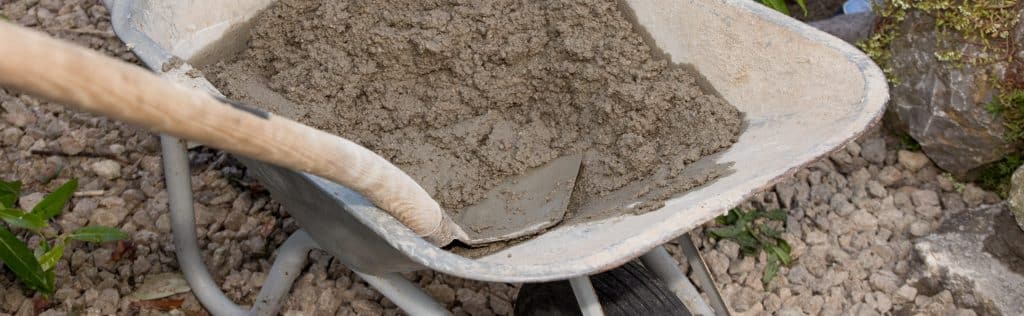
For all small masonry jobs (jointing, sealing, repairs,…) requiring only a few liters of concrete or mortar, mixing can be done by hand rather than with a concrete mixer. The components are then mixed using a shovel, in a mixing tray or for smaller quantities in a hollow or awheelbarrow with the help of a trowel. How to make concrete or mortar by hand?
A few reminders: difference between concrete and mortar
Mortar and concrete are part of the common vocabulary of DIY work. Yet, we often observe a certain confusion regarding the characteristics and uses of these materials, which forces us to revisit the fundamental principles (Link Article TSLB).
Mortar is composed of water, cement, and sand. It is mainly used for making plaster, assembling bricks, or building a wall with concrete blocks, making screeds, or sealing tile elements.
Standard concrete is a mixture of sand, cement (hydraulic binder), water, and gravel. Thanks to the presence of gravel, it functions more mechanically than mortar. Thus, any type of structural work and structural elements can be done with concrete: making a slab, foundation, beams, posts, walls…
The necessary tools
To mix concrete by hand, certain tools are essential. These are:
- a container: mixing tray, trough, or wheelbarrow;
- a mixing tool: shovel or trowel depending on the volume to be mixed;
- a graduated mason’s bucket with a capacity of 10 liters to measure the ingredients.
The supply of materials
If you decide to make your concrete by hand, you need to purchase and supply in advance the materials (bag of cement, sand, gravel) necessary to obtain concrete.
The quantities of materials to be supplied are as follows:
- To make 1 m3 of mortar: 400 kg of cement and 1400 kg of sand are required.
- To make 1 m3 of concrete for routine work: 350 kg/m3 of cement, 680 kg of sand, and 1180 kg of gravel are required.
- To make 1 m3 of foundation concrete (lower cement dosage): 300 kg of cement, 720 kg of sand, and 1160 kg of gravel are needed.
The dosage of concrete or mortar in a bucket
The dosage is generally done by reasoning in volumes, using a graduated 10-liter mason’s bucket. This method is easy to perform, it works at any time, but the dosage of concrete remains approximate.
The usual dosages are:
- Mortar dosage: 1 volume of cement, 3 volumes of sand, and half a volume of water.
- Concrete dosage for routine work: 1 volume of cement, 2 volumes of sand, 3 volumes of gravel, and half a volume of water (rule known as “1, 2, 3”).
- Foundation concrete dosage: 1 volume of cement, 2.5 volumes of sand, 3.5 volumes of gravel, and half a volume of water.
Convert liters to kg and vice versa. For this purpose, the density helps to perform your volume to kilogram conversions: The capacity of your measuring tool (mason’s bucket) is measured in liters. To calculate precise dosages, or to determine the amount of materials to supply, you may need to know the density of each component used.
Here are the main quantities to consider when converting:
- 1000 liters (i.e., 1 m3) of gravel weigh about 1500 kg;
- 1000 liters of dry sand weigh about 1600 kg;
- 1000 liters of cement weigh between 1000 and 1100 kg.
The steps for making concrete or mortar
The manual mixing of concrete or mortar is carried out in the following steps:
1. Mix the constituents to
dry
- If you are making concrete, start by placing the gravel in the container intended for mixing (mixing tray, trough, or wheelbarrow).
- Pour in the planned amount of sand, then cement.
As a reminder, if you are preparing mortar, do not add gravel!
- Mix well with a shovel (or a trowel if you are using a trough). The mixture should be uniform and the cement well distributed. If you are using a mixing tray, to properly homogenize, you can make a bouquet with the mixture and move it 2 or 3 times.
2. The wetting
- Dig a crater at the top of the pile with the shovel.
- Pour 2/3 of the planned wetting water.
- Gradually soak the mixture by sliding the inner edges of the crater into the water using the back of the shovel.
- Turn the shovels so that the mixture is moist.
Wetting the concrete.
3. Mixing
- Stir the mixture, by gradually pouring in the remaining water, until the desired consistency is obtained.
- Once the concrete has reached the correct consistency, pour it into the trough or wheelbarrow and use it within an hour.
- After pouring the concrete, do not forget to wash the material used for mixing with water.
Mixing concrete in a trash can.
What is the right consistency for concrete or mortar?
It is very easy to ruin concrete or mortar if you add too much water to the mixture. In this case, the material separates (the gravel sinks and the water rises to the surface).
Even though the temptation is great to make a very liquid concrete to make it easier to place, it is important to know that excess water causes a drop in concrete strength and increases the risk of cracking. Therefore, it is recommended not to exceed the recommended amounts of water.
The optimal consistency for concrete: the concrete should be soft enough, but not too liquid. A test you can perform to assess the consistency is to make a mound with the concrete. If the mound holds its shape after a few minutes, the consistency of the concrete is correct. If the mound collapses on itself, it is because it is too wet. In this case, it is possible to compensate for the correct consistency by adding cement, sand, and gravel in the right proportions.
The optimal consistency for mortar: the mortar should be soft and creamy. If it is properly moistened, it should be easily smoothed with a trowel and a thin film of water should rise to the surface when passing the shovel blade over it.
Advantages and disadvantages of hand-made concrete
Making concrete by hand can be practical if you do not have a concrete mixer and want to make a very small amount of concrete (<100 liters) for a non-critical job.
Only the dosage of concrete in a bucket is not very simple. Mixing concrete manually is very laborious even for small quantities. And it is not easy to make the mixture very homogeneous and thus have quality concrete.
So why not choose to have ready-mixed concrete delivered?
Tag: pouring a concrete slab